
After reading the previous article, I believe you already understand what 3D and 2D teaching materials are. Here, I would like to briefly explain their purposes in teaching: 3D materials are used to build foundational understanding, while 2D materials are used to consolidate and expand concepts. So why is it more effective to start with 3D learning and then move on to 2D to extend concepts?
Today, I would like to introduce the first key benefit, using an example that you may have encountered before. If a child is first taught what a dog is using 2D picture cards, such as a Dalmatian card, the child may only recognize that specific Dalmatian image. When shown a different dog card—such as a Golden Retriever, or even a cartoon Dalmatian—the child may fail to recognize it. This relates to generalization ability (the ability to apply a learned concept to examples with different appearances or forms). In this situation, the child is unable to generalize. Why does this happen?
It is because 3D toy dogs were not used as the first learning step, so the child has not built an accurate understanding of what a “dog” is as a living being. I believe that starting with 3D materials helps children build the most accurate understanding of concepts more effectively.
So, when learning the concept of “dog,” how exactly do 3D toy dogs help children build correct understanding?
When teaching with 2D picture cards, the image usually shows only one angle. The child may see only part of the body—perhaps only half of the dog, or even just three legs—without seeing the dog’s full structure. When the concept is not properly established, the child may create an oversimplified rule, such as “anything with four legs is a dog.” As a result, when the next picture card shows a dog from an angle where only three legs are visible, the child may think it is not a dog.
However, when using a 3D dog figure, children can physically manipulate it and observe the dog from multiple angles. They can see the proportions of the head, body, and limbs, and even compare dogs with other animals. Through observation and comparison, children gradually discover that having four legs alone does not define a dog. They begin to notice multiple features, instead of relying on a single characteristic to define the concept.
In addition, 3D materials offer another important function in building accurate understanding: opportunities for self-correction. 3D materials provide immediate, real-world feedback. Unlike 2D materials, which often require adults to mark answers as right or wrong, 3D materials allow children to think independently and adjust their understanding on their own.
Here are some concrete examples of how children can self-correct using 3D materials:
Now I will use the concept of “more and less” as an example of transitioning from 3D to 2D learning, to illustrate why 3D learning should be the starting point.
Step 1: Animal toys + identical-sized boxes (visual support)
Step 2: Put 6 animals into one box and 2 animals into another box

Step 3: Animal toys + identical-sized frames (visual support)
Step 4: Put 5 animals into one frame and 2 animals into another frame
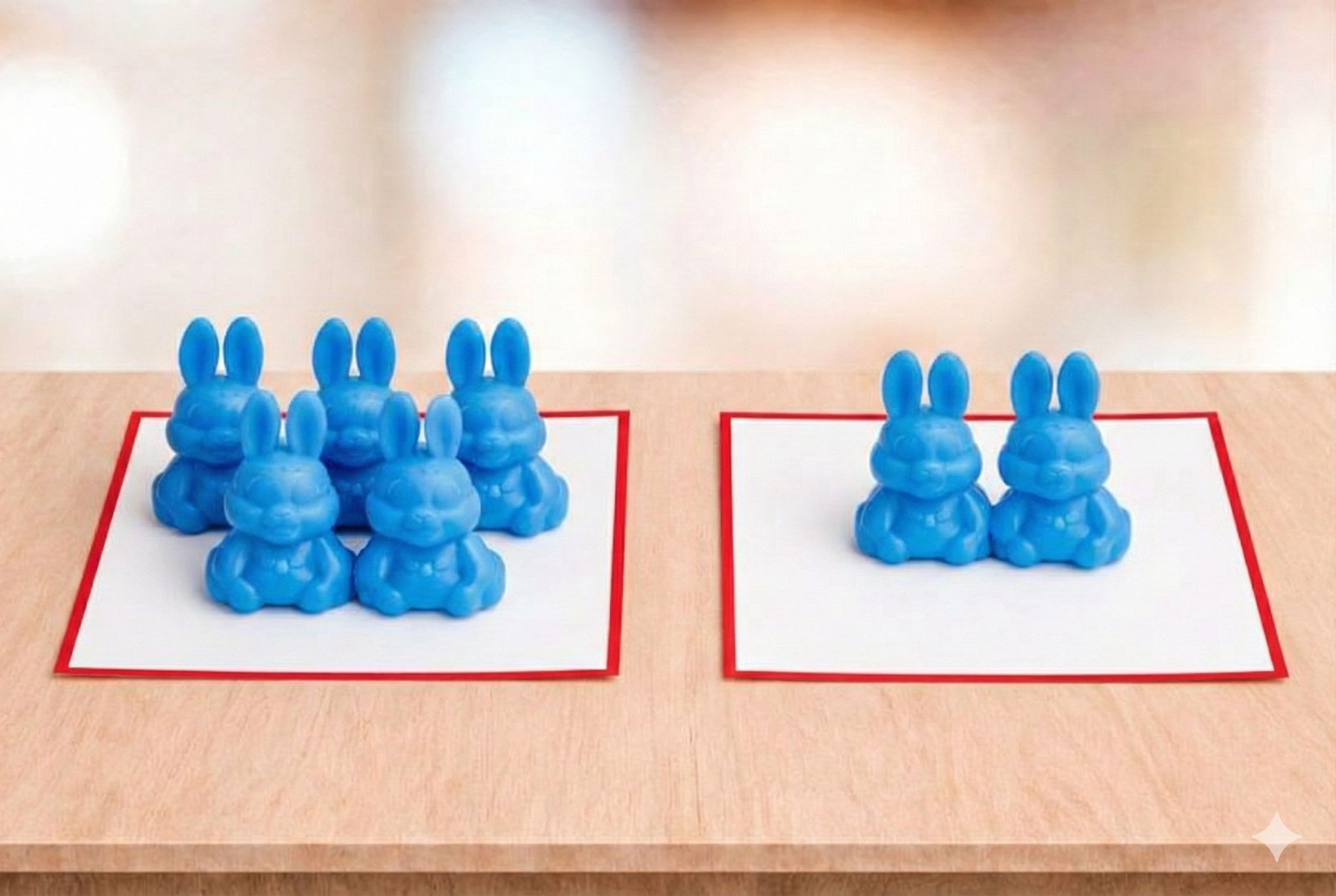
Step 5: Place animal toys freely on the left and right sides of the table
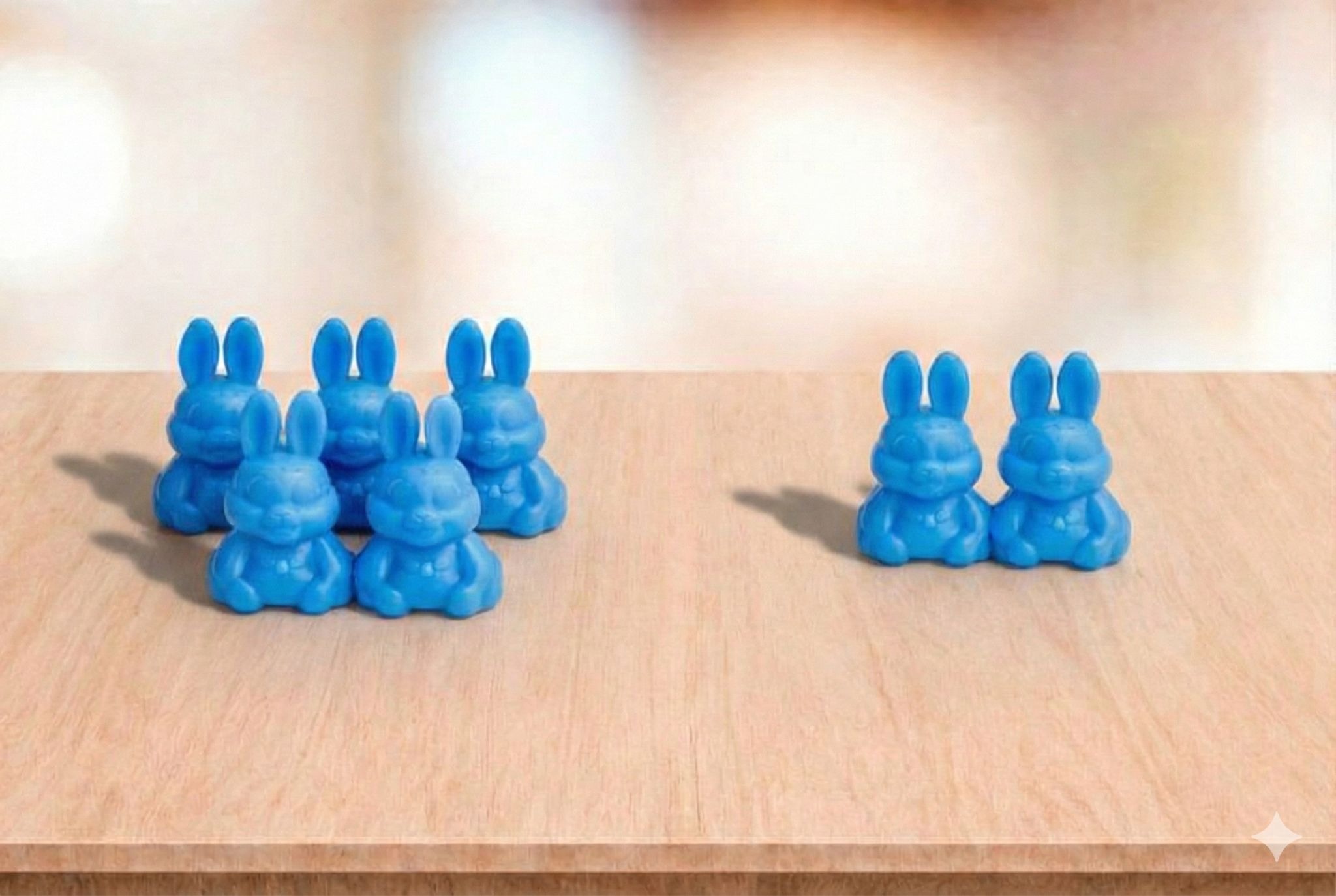
(One type of animal succeeds in Steps 1–5 → then move on to mixed animals in Steps 1–5)
Step 6: 2D learning of the “more and less” concept
Throughout this process, children can observe that when there are more animals, the box has little or no empty space, while when there are fewer animals, there is more empty space inside the box or frame. Boxes and frames act as mediating tools that help children understand the concept of boundaries and space. Having a fixed 3D boundary makes it easier to understand “more” and “less,” gradually helping children build an accurate concept of quantity.
Encouraging the use of 3D materials as the starting point of teaching does not mean that once children learn with 3D materials, they will automatically answer all 2D tasks correctly later. It is important to understand that 2D materials are more abstract, variable, and less connected to real life than 3D materials. Precisely because of this, a strong foundation built through 3D learning is essential.
3D teaching helps children form a complete, comparable, and comprehensible core concept. With this solid conceptual core, children are far less likely to become confused by variations in 2D materials.
In the next article, I’ll continue to share another important benefit of 3D → 2D learning, and how it further supports children as their understanding deepens.